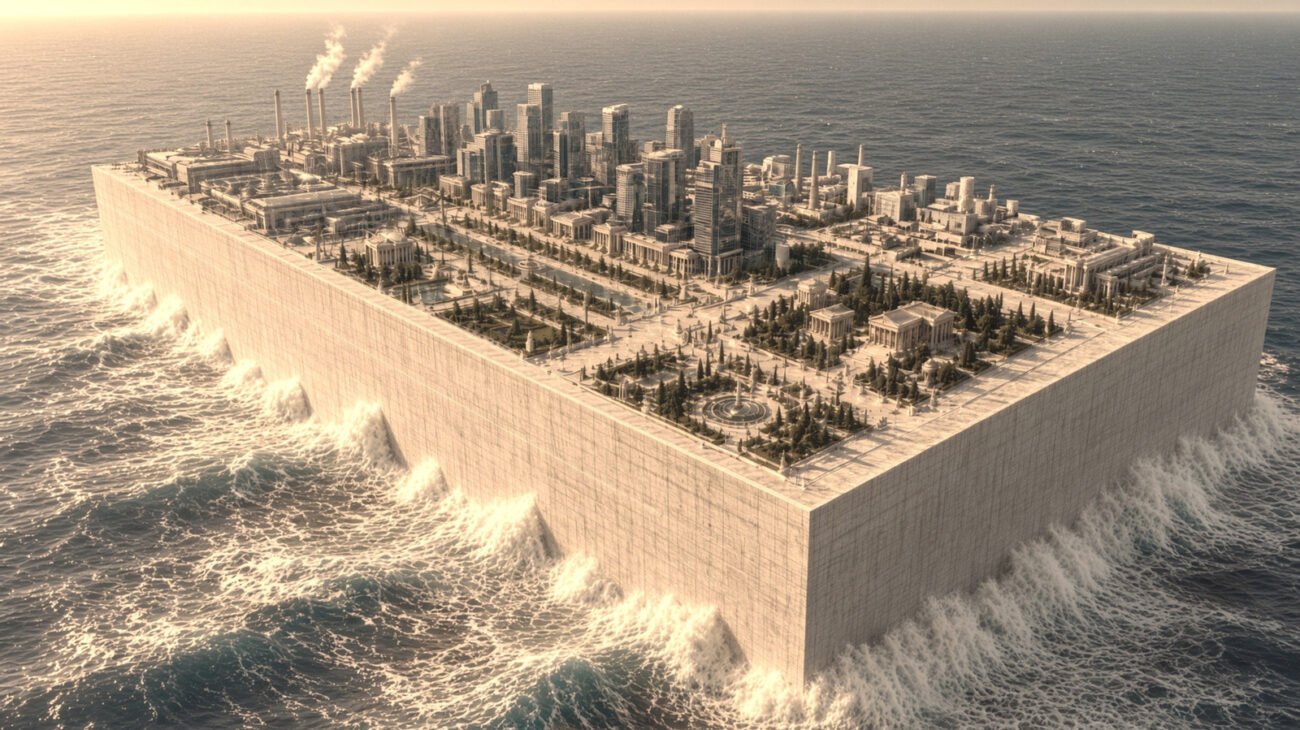
Technical Specifications and Architectural Breakdown
The engineering requirements for a structure intended to endure for a millennium are orders of magnitude more complex than those of contemporary offshore oil platforms or cruise vessels. A standard oil rig is designed for a service life of 20 to 30 years, often relying on constant maintenance and proximity to supply chains. The SLAB Seastead, conversely, utilizes a modular, semi-submersible architecture intended to mitigate the corrosive and kinetic stresses of the open ocean. The structural skeleton is expected to rely on advanced composite materials and high-grade marine concrete, which gain strength through hydration over time, rather than traditional steel, which is prone to fatigue and oxidation.
The platform’s design prioritizes modularity to allow for organic growth. As industrial partners join the initiative, the base structure can be expanded by appending additional “slabs”—self-contained units that house localized power generation, refineries, and research labs. This integration is critical: by co-locating manufacturing and energy production, the project minimizes the logistical overhead associated with land-based supply chains. Furthermore, the SLAB architecture incorporates active ballast systems and hydrodynamic damping to ensure stability during extreme weather events, effectively decoupling the facility’s internal operations from the unpredictable nature of the marine environment.
Industry Landscape and Competitive Comparison
The concept of seasteading is not new. Previous iterations, ranging from the micronation of Sealand to the various libertarian-driven blueprints of the early 2010s, largely failed due to a lack of economic viability. These earlier projects were often treated as residential experiments or ideological retreats. The SLAB Seastead distinguishes itself by framing the ocean as a competitive industrial asset. It is a power-multiplier for corporations that require rapid prototyping and environmental testing without the interference of local zoning boards or bureaucratic oversight.
| Attribute | Mainland Industrial Park | Legacy Seasteading Projects | SLAB Seastead |
|---|---|---|---|
| Regulatory Control | Heavy Government Oversight | Nominal/Non-existent | Autonomous/Self-Governing |
| Primary Objective | Compliance and Stability | Ideological Autonomy | Industrial Throughput |
| Structural Longevity | Indefinite (Maintenance-heavy) | Low (Temporary) | High (1,000-year design) |
Practical Consumer & Enterprise Takeaways
For enterprise stakeholders, the SLAB Seastead represents a high-risk, high-reward logistical upgrade. The primary benefit is the reduction of “regulatory latency”—the time lost waiting for permits, environmental impact assessments, and compliance audits. In industries like aerospace, advanced materials, and high-energy research, this latency can be the difference between market leadership and obsolescence. However, the cost-benefit trade-off is significant. Moving operations to the open ocean necessitates a shift in human resource strategy; attracting top-tier engineering talent to a remote, offshore facility requires providing a standard of living and connectivity that matches or exceeds mainland urban centers.
Companies considering this move must evaluate their dependence on terrestrial supply chains. While the SLAB platform aims for self-sufficiency, the reality of global trade means that raw material procurement and the export of finished goods will still require a robust, ocean-based logistics network. Organizations should view the SLAB not as a total escape from the global economy, but as a specialized, high-velocity environment for the most sensitive or regulated phases of production.
Frequently Asked Questions
How does the SLAB Seastead handle the legal complexities of international maritime law?
The project leverages the United Nations Convention on the Law of the Sea (UNCLOS). By operating outside of Exclusive Economic Zones (EEZs), the platform functions as a vessel under the flag of a specific jurisdiction, or in more ambitious scenarios, seeks to establish its own independent governance framework. Legal experts note that while this provides a degree of autonomy, the platform must still contend with international safety and environmental standards to avoid being classified as a hazard to navigation.
What are the primary energy sources for a facility of this size?
Given the requirement for heavy industrial output, the platform is projected to utilize a mix of modular nuclear reactors, such as Small Modular Reactors (SMRs), and high-capacity wave and wind energy harvesting. The goal is to achieve total power independence, ensuring that the facility remains operational regardless of external grid stability or fuel supply fluctuations.
Is the SLAB Seastead intended for residential use or purely industrial operations?
While the project is framed as an industrial power-multiplier, the scale required for 1,000-year structural integrity necessitates a permanent, highly skilled workforce. Therefore, the architecture includes high-density, high-comfort residential zones. However, the primary focus remains on the industrial output, with residential life secondary to the operational requirements of the research and manufacturing facilities.
The Bottom Line
The SLAB Seastead represents a bold, if technically daunting, attempt to redefine the relationship between industrial innovation and state regulation. By moving beyond the limitations of land-based geography, Luckey and his team are testing the hypothesis that true technological acceleration requires a blank slate. While the engineering hurdles are immense and the geopolitical implications remain uncertain, the project serves as a clear signal that the next frontier for industry may not be in space, but on the high seas. For firms struggling under the weight of bureaucratic stagnation, the SLAB offers a compelling, albeit expensive, alternative. Whether it can maintain its autonomy in the face of global regulatory pushback remains the defining question of its long-term viability.
