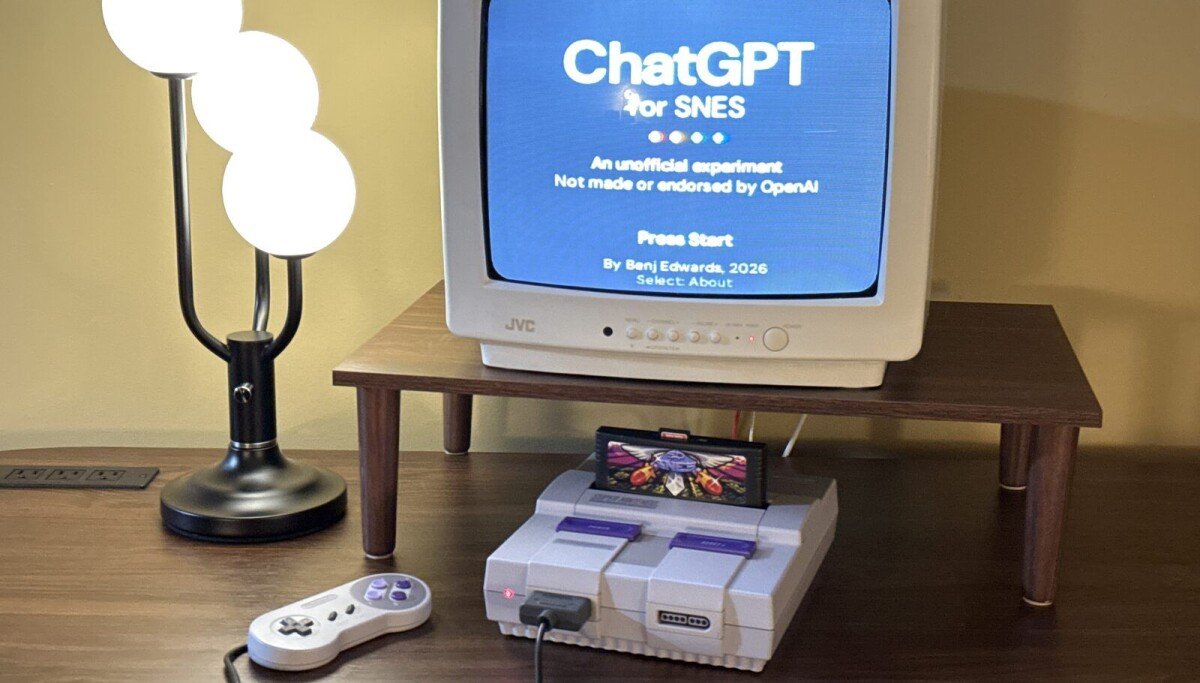
Technical Specifications and Architectural Breakdown
The technical achievement behind ChatGPT for SNES rests upon a radical reduction in model complexity. At the heart of the project is a 2.2 million-parameter model derived from OpenAI’s GPT-OSS-120b architecture. To put this into perspective, modern Large Language Models (LLMs) operate with parameters numbering in the hundreds of billions, often requiring massive GPU clusters to maintain inference speeds. Fitting even a fraction of this logic into a 4MB footprint for the base version—and 19MB for the enhanced version—required significant quantization and pruning.
The Super Nintendo itself was never designed for floating-point operations or the high-dimensional vector math required by transformer models. To circumvent this, the project utilizes the Super FX graphics coprocessor. Originally engineered to render 3D polygons in titles like Star Fox, the Super FX chip provides the necessary arithmetic logic unit (ALU) throughput to process the model’s weights. The data is stored on a custom flash-memory cartridge that feeds the SNES CPU, which acts primarily as an I/O controller, managing the user interface and memory addresses while the coprocessor handles the heavy lifting of token prediction.
Memory management remains the primary bottleneck. With only 128KB of work RAM available on the base console, the system must perform aggressive paging to access the 19MB dataset stored in the cartridge. This results in significant latency; the model does not generate text in the fluid, real-time manner users expect from cloud-based interfaces. Instead, the process is iterative and slow, highlighting the physical realities of 1990s-era bus speeds and the inherent inefficiency of running neural networks on hardware that lacks modern cache hierarchies or branch prediction.
Industry Landscape and Competitive Comparison
In the broader industry, ChatGPT for SNES sits at the extreme end of the “Edge AI” spectrum. While companies like Apple and Qualcomm race to integrate Neural Processing Units (NPUs) into mobile SoCs to run small models locally, this project demonstrates the theoretical floor of such operations. It is not a viable commercial product, but rather a benchmark for how much “intelligence” can be extracted from legacy systems. When compared to current edge solutions, the performance gap is stark.
| Specification | Standard Cloud AI | Edge AI (NPU-based) | ChatGPT for SNES |
|---|---|---|---|
| Model Size | Terabytes | 1GB – 7GB | Under 20MB |
| Inference Latency | Milliseconds | Sub-second | Seconds to Minutes |
| Accuracy | High | Moderate | Experimental/Low |
| Hardware Cost | Subscription-based | $800 – $2,000 | Vintage Hardware + Custom Cart |
The comparison highlights a critical reality: AI performance is inextricably linked to the hardware’s ability to handle high-bandwidth memory access. While cloud AI benefits from massive data centers and edge AI relies on specialized silicon, the SNES implementation relies on sheer engineering ingenuity to bypass the limitations of a 3.58 MHz processor. It is a proof of concept that demonstrates how specialized coprocessors can be repurposed, yet it also underscores the impossibility of bridging the gap between 16-bit logic and modern natural language processing without massive architectural compromises.
Practical Consumer & Enterprise Takeaways
For the average consumer or enterprise user, the lessons from ChatGPT for SNES are clear: hardware remains the primary constraint for local AI deployment. While the industry is trending toward smaller, more efficient models, there is a hard limit to what can be achieved without dedicated hardware acceleration. Businesses looking to implement local AI solutions must prioritize devices with sufficient NPU throughput and high-speed unified memory architectures.
Furthermore, the project serves as a cautionary tale regarding “model distillation.” While developers can shrink models to fit into smaller footprints, the loss in semantic nuance and factual accuracy is profound. Organizations should be wary of marketing claims suggesting that “lightweight” models can replace the capabilities of full-scale, cloud-hosted LLMs. The cost-benefit trade-off currently favors cloud-based inference for any task requiring high reasoning capabilities, while local models are best reserved for simple, deterministic tasks where data privacy is the primary concern.
Frequently Asked Questions
Is ChatGPT for SNES actually running the full ChatGPT engine?
No. It is running a highly pruned, 2.2 million-parameter derivative model. It lacks the training data, reasoning depth, and contextual memory of the full-scale ChatGPT models found on OpenAI’s servers.
Can I use this to improve my SNES gaming experience?
The project is not intended for gaming enhancement. It is a purely technical demonstration. The processing overhead required for the model leaves no room for the console to simultaneously render complex graphics or handle gameplay logic.
Does this mean old hardware can be “upgraded” to modern standards?
This project proves that legacy hardware can be pushed beyond its original design parameters, but it does not equate to a functional upgrade. The speed and accuracy limitations are inherent to the physical architecture and cannot be overcome with software optimizations alone.
The Bottom Line
ChatGPT for SNES is a fascinating exercise in technical limitation, pushing a 1990s console to perform tasks that were mathematically inconceivable at the time of its release. However, it is essential to view this project through the lens of academic curiosity rather than practical utility. It confirms that while algorithms can be compressed, the physical laws governing compute cycles, bus speeds, and memory bandwidth remain immutable. As we move toward an era of ubiquitous local AI, this experiment stands as a reminder that the quality of our digital intelligence is only as robust as the silicon it inhabits.

3 thoughts on “ChatGPT for SNES Reveals Limits of Vintage Hardware”