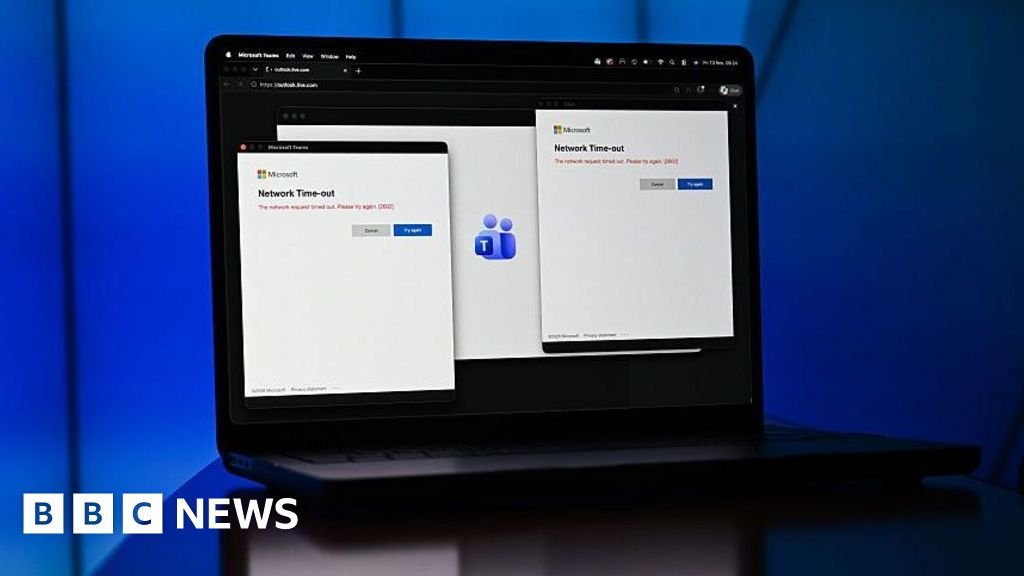
Technical Specifications and Architectural Breakdown
To understand the scope of the Microsoft Cloud Failure, one must examine the complexity of modern hyperscale data centers. The incident originated in the orchestration layer, which governs the distribution of traffic across global regions. During a routine capacity expansion, a configuration error was introduced into the software-defined networking (SDN) protocols. In a hyperscale environment, these protocols are designed to automate load balancing and traffic routing; however, they also create a single point of failure if the propagation of a faulty update is not strictly gated.
The architecture relies on massive, distributed clusters that synchronize state information in real-time. When the erroneous configuration was pushed, it triggered a cascading failure across the control plane. Because the underlying hardware remained operational, the system entered a “zombie state” where servers were powered on but unreachable, leading to a total loss of service visibility. Recovery was hampered by the sheer volume of telemetry data generated by millions of interconnected nodes, all attempting to re-establish handshakes simultaneously. This “thundering herd” problem meant that manual intervention was required to throttle traffic and segment the network, turning a routine upgrade into a 24-hour restoration ordeal.
Industry Landscape and Competitive Comparison
The centralization of cloud services has created an oligopoly where three providers—Microsoft, Amazon, and Google—control a vast majority of the world’s digital backbone. While these providers offer unparalleled efficiency, the trade-off is a lack of architectural diversity. When one provider falters, the ripple effects are felt across sectors that have no direct relationship with the vendor, as seen in the disruption of rail networks and government offices. The following table contextualizes this event against historical industry benchmarks to highlight the growing challenge of managing hyper-scale systems.
| Outage Event | Primary Cause | Duration | Scope of Impact |
|---|---|---|---|
| 2024 Microsoft Incident | Upgrade Error | ~24 Hours | Global Infrastructure |
| Historical AWS Outage | Human Error (S3) | ~5 Hours | Regional/Platform |
| Cloud Provider X | Power Failure | ~8 Hours | Regional Data Center |
The data demonstrates that while previous outages were often contained within specific regional availability zones, the Microsoft Cloud Failure highlights the vulnerability of the global control plane. As systems become more interconnected to support AI-driven workloads and real-time data processing, the margin for error during maintenance windows continues to shrink. The industry is reaching a point where the complexity of these networks may be outpacing the human and automated safeguards intended to manage them.
Practical Consumer & Enterprise Takeaways
For enterprise leaders and IT decision-makers, the incident serves as a mandate to revisit business continuity planning. Relying on a “single-cloud” strategy is no longer a viable risk-mitigation posture for mission-critical operations. Organizations should prioritize a multi-cloud or hybrid-cloud approach, ensuring that core services can be failed over to independent infrastructure providers in the event of a primary provider outage. This, however, introduces significant cost and complexity, as data sovereignty and interoperability between clouds remain persistent hurdles.
For smaller businesses and consumers, the takeaway is the necessity of offline redundancy. Digital transformation has often come at the expense of manual contingency plans. Businesses that lack a “paper-trail” or offline backup for critical transactions found themselves unable to function during the 24-hour window. Moving forward, procurement strategies should include rigorous Service Level Agreement (SLA) audits, specifically focusing on the provider’s rollback procedures and the granularity of their traffic-shaping capabilities. Investing in local edge computing—where essential services run on-premises—is a growing trend for sectors where downtime is not an option.
Frequently Asked Questions
Could this outage have been prevented by better AI monitoring?
While AI is increasingly used for anomaly detection, it can also exacerbate failures if the AI itself is trained on flawed telemetry or if it automates the propagation of the error. In this instance, the failure was a logic error in the configuration, which traditional monitoring systems often misinterpret as legitimate traffic spikes or capacity adjustments.
Is “multi-cloud” a realistic solution for small to medium-sized enterprises?
Multi-cloud is often prohibitively expensive for smaller entities due to the need for specialized engineering talent to manage disparate APIs and data synchronization. For these organizations, a better approach is to identify the “must-have” services that require high availability and ensure those specific components have an offline or secondary cloud contingency, rather than attempting to mirror the entire infrastructure.
What is the primary risk of centralized cloud architecture in the long term?
The primary risk is systemic fragility. As more societal functions—from healthcare records to financial clearinghouses—migrate to the cloud, the “blast radius” of any single administrative error increases. The long-term risk is that the infrastructure becomes “too big to fail” but too complex to manage without intermittent, high-impact disruptions.
The Bottom Line
The Microsoft Cloud Failure is a watershed moment for the tech industry. It exposes the inherent tension between the efficiency of centralized, hyper-scale cloud environments and the necessity of operational resilience. While the provider’s recovery efforts were ultimately successful, the 24-hour disruption of critical global services is an unacceptable benchmark for the modern era. The path forward requires a shift in how we view cloud infrastructure: not as a utility that can be taken for granted, but as a complex, fragile system that requires significant investment in redundancy, regional isolation, and manual fail-safe protocols. The industry has been warned; the next step must be a collective commitment to architectural diversity over the convenience of single-vendor dominance.
