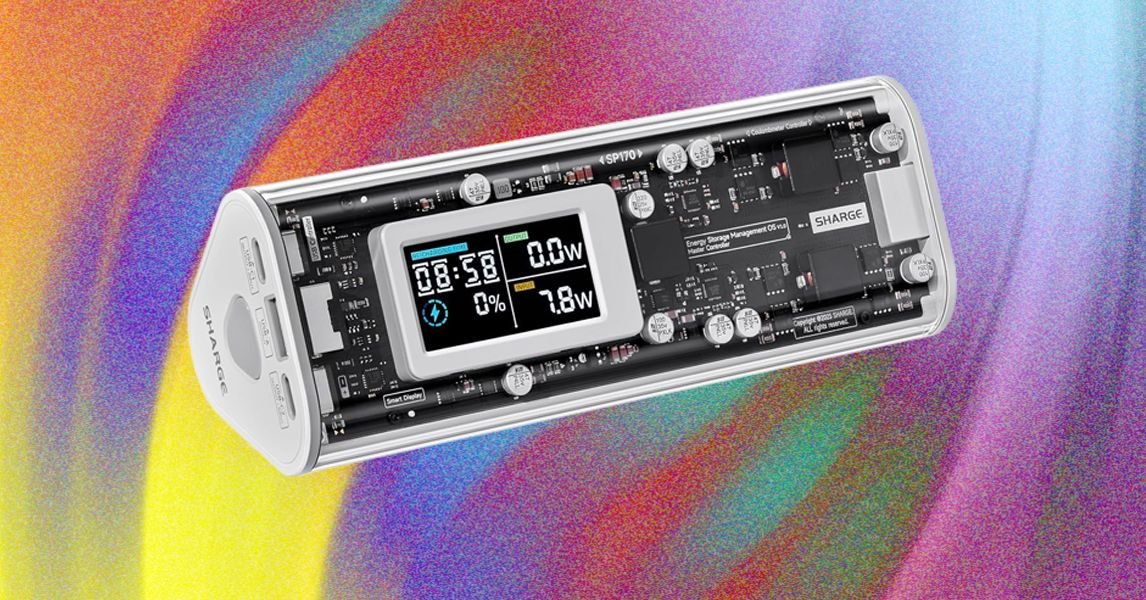
Technical Specifications and Architectural Breakdown
The engineering philosophy behind this unit centers on the necessity of high-density energy management. At its core, the device boasts a 165-watt total output capacity, a figure that provides the necessary headroom for modern ultrabooks and tablets that demand sustained 100-watt Power Delivery (PD) inputs. Unlike legacy power banks that throttle output when multiple ports are engaged, this unit utilizes advanced circuitry to maintain stability across four simultaneous connections.
A critical component of this architecture is the integration of an intelligent OLED display. While many competitors rely on imprecise LED indicators—which often provide misleading data regarding state-of-charge—this display offers real-time telemetry. Users can monitor input/output wattage, the health of the internal cells, and the remaining cycles. This level of transparency is essential for managing long-term battery degradation, a common failure point in high-capacity portable storage. By utilizing sophisticated power distribution protocols, the device ensures that the handshake between the power bank and the host laptop is seamless, preventing the power-cycling issues that frequently plague lower-tier hardware during heavy processing loads.
Industry Landscape and Competitive Comparison
The market for portable energy is currently saturated with hardware that fails to meet the requirements of modern USB-PD standards. Many legacy models utilize outdated circuitry that lacks the necessary handshake protocols to negotiate high-wattage charging, often resulting in the laptop refusing to draw power entirely. When comparing the Anker unit against industry averages, the disparity in performance becomes clear. While the standard 20,000-mAh unit typically struggles to provide more than 60 watts of total output, the Anker 25,000-mAh model provides a significant buffer for power-hungry hardware.
| Metric | Anker 25k Model | Industry Standard (20k mAh) | Legacy 15k mAh Unit |
|---|---|---|---|
| Total Wattage | 165W | 60W | 30W |
| Capacity | 25,000 mAh | 20,000 mAh | 15,000 mAh |
| Max Single Port | 100W | 45W | 18W |
| Airline Approval | Yes (99.5Wh) | Yes | Yes |
The data highlights a clear trajectory: manufacturers are moving toward higher wattage density to accommodate the power-hungry nature of modern mobile workstations. The Anker model succeeds by balancing this density with safety, ensuring that the 25,000-mAh capacity remains within the 100-watt-hour limit mandated by most international aviation authorities for carry-on luggage.
Practical Consumer & Enterprise Takeaways
For the enterprise user, the decision to invest in high-capacity power solutions is often a matter of productivity. A laptop power bank that cannot sustain a full workday of operations is essentially an expensive paperweight. When evaluating these units, users must look beyond the “mAh” rating, which is frequently marketed as the sole indicator of power. Instead, the focus should be on the sustained wattage output and the efficiency of the power conversion process.
Upgrade considerations should prioritize the device’s ability to handle multiple devices simultaneously. Professionals often carry a laptop, a smartphone, and a secondary peripheral, such as a tablet or a set of noise-canceling headphones. The ability to distribute 165 watts across four ports allows for a centralized charging hub, reducing the number of individual wall adapters required for travel. While the initial cost of such a high-performance power bank is higher than entry-level alternatives, the cost-benefit trade-off favors the higher-end unit due to its improved cycle life and the reduction in downtime during critical work hours.
Frequently Asked Questions
Does the 165-watt output damage smaller devices like smartphones or earbuds?
No. Modern USB-PD protocols are designed to be “smart.” The power bank and the connected device perform a handshake to determine the maximum safe voltage and amperage the device can accept. The power bank will automatically throttle its output to match the requirements of the connected device, ensuring safe charging for everything from high-draw laptops to low-draw wearables.
How does the OLED display help with long-term battery health?
The OLED display provides visibility into the power bank’s internal health metrics. By monitoring the input and output wattage, users can identify if a specific cable or device is causing inefficient power delivery. Furthermore, observing the discharge rate helps users understand how their specific laptop usage patterns affect the bank’s longevity, allowing for better management of charging cycles.
Is the 25,000-mAh capacity problematic for air travel?
The capacity of this specific unit is engineered to stay just under the 100-watt-hour (Wh) threshold typically enforced by the FAA and other international aviation bodies. Since 25,000 mAh at a nominal 3.7V equates to 92.5Wh, it remains compliant with standard airline regulations for carry-on items. However, users should always verify the specific policies of their airline before boarding.
The Bottom Line
The Anker 25,000-mAh power bank represents a maturation of the portable charging market. By prioritizing high-wattage output, intelligent power management, and user-facing telemetry, it addresses the primary frustrations of the mobile professional. While the market is flooded with lower-cost alternatives, the technical stability and efficiency offered by this unit provide a tangible advantage for those whose work depends on consistent access to power. It is a reliable, well-engineered tool that sets a clear standard for what a portable power solution should achieve in the current era of high-performance computing.
