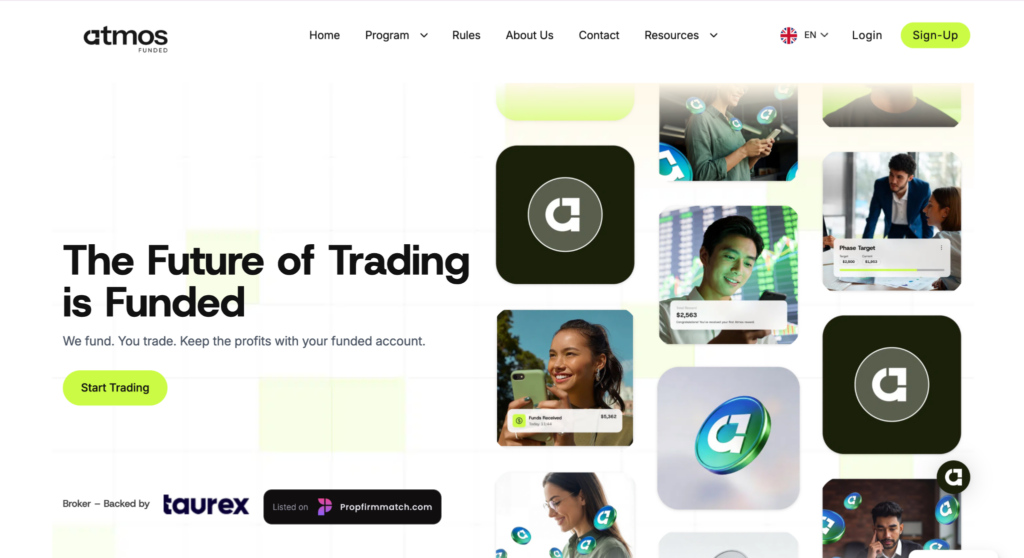
Technical Specifications and Architectural Breakdown
Atmos Funded operates on a sophisticated technical stack designed to mirror the latency and execution quality of professional institutional environments. The platform is built upon the MetaTrader 5 (MT5) infrastructure, a choice that provides multi-asset capabilities, advanced charting tools, and algorithmic trading support through MQL5. This integration ensures that traders can deploy automated strategies, backtest historical data, and execute trades with minimal slippage—a critical requirement for high-frequency or precision-based trading.
The platform’s architectural robustness is further bolstered by its partnership with Taurex, which functions as the liquidity and execution backbone. This integration facilitates a seamless transition from the evaluation phase to a funded account status. From a technical standpoint, the platform supports a diverse array of asset classes, including major and exotic currency pairs, commodities, and various crypto-assets. To maintain the integrity of the simulated environment, the firm enforces a leverage cap of 1:50. This constraint is not merely a regulatory nod but a strategic component of their risk management architecture, forcing participants to adhere to disciplined position sizing rather than over-leveraging their simulated capital.
Security and data integrity are managed through encrypted gateways that handle trade execution and reporting. The firm utilizes a proprietary dashboard that tracks real-time drawdown metrics, profit targets, and risk parameters. By automating these performance reviews, Atmos Funded removes the subjectivity often found in manual trading assessments, providing a transparent, data-driven path to capital allocation.
Industry Landscape and Competitive Comparison
The proprietary trading sector has seen an influx of providers, each attempting to capture a share of the retail market by adjusting entry costs and payout structures. While established players like E8 Markets have set high benchmarks with substantial total payouts exceeding $35 million, the market is currently pivoting toward accessibility. Atmos Funded has carved out a niche by focusing on ultra-low entry pricing, specifically through its Nova challenge, which lowers the barrier to entry for traders who may not have the capital to commit to more expensive, high-stakes evaluations.
The following table outlines how Atmos Funded compares to other prominent models in the current ecosystem, focusing on key performance indicators relevant to the retail trader.
| Feature | Atmos Funded | E8 Markets | Traditional Retail Broker |
|---|---|---|---|
| Entry Cost | Low (Nova Challenge) | Moderate | Variable (Capital Dependent) |
| Trading Platform | MetaTrader 5 | MT4/MT5/DXtrade | Proprietary/MT5 |
| Capital Risk | Simulated (Firm-backed) | Simulated (Firm-backed) | Personal Capital |
| Leverage | Capped at 1:50 | Up to 1:100 | High (Up to 1:500) |
When selecting a firm, traders must weigh the importance of payout frequency against the strictness of the evaluation criteria. While some firms offer faster payouts, they often pair these with more aggressive drawdown limits. Atmos Funded’s strategy appears to favor a balance between entry affordability and standardized risk protocols, positioning it as an attractive option for both intermediate traders looking to scale and novices seeking a controlled environment.
Practical Consumer & Enterprise Takeaways
For the Indian retail trader, the decision to engage with a firm like Atmos Funded should be predicated on a clear understanding of the “funded” model. Unlike a traditional brokerage account where the trader owns the underlying assets, these platforms offer a profit-sharing arrangement based on simulated performance. Traders are essentially purchasing an opportunity to demonstrate their skill, not an investment vehicle.
Before committing capital, potential users should evaluate their own risk tolerance. The 1:50 leverage limit is a protective measure, but it requires a disciplined approach to technical analysis. Traders who rely on high-leverage “gambling” strategies will likely fail the evaluation phase quickly. Conversely, those who utilize systematic, risk-managed strategies will find the platform’s infrastructure conducive to long-term growth. Furthermore, the 10% deposit bonus for internal accounts provides a tangible incentive for those who intend to commit to the platform for the long term, effectively lowering the cost of entry even further.
Frequently Asked Questions
How does the evaluation process differ from live trading?
The evaluation process uses simulated market data to assess a trader’s ability to follow risk management rules and reach profit targets. While the execution environment mirrors live markets, the capital is not real; therefore, the trader incurs no personal financial loss if the trade fails, beyond the initial evaluation fee.
What happens if a trader exceeds the drawdown limit?
If a trader hits the maximum allowable drawdown, the account is typically terminated. This is a standard industry practice designed to protect the firm’s capital. Traders are usually required to purchase a new challenge to restart the process, highlighting the importance of strict stop-loss implementation.
Are these platforms regulated in India?
Proprietary trading firms operating internationally often exist in a regulatory gray area regarding Indian forex laws. Traders should consult with financial advisors to understand the tax implications of profit withdrawals and the legal status of international simulated trading firms within their specific jurisdiction.
The Bottom Line
Atmos Funded represents a pragmatic evolution in the retail trading sector, particularly for markets like India where capital efficiency and risk mitigation are paramount. By leveraging the MetaTrader 5 ecosystem and maintaining a disciplined 1:50 leverage cap, the firm offers a professional-grade environment that prioritizes sustainable trading habits over speculative excess. While the model requires a shift in mindset from asset ownership to performance-based profit sharing, the low entry costs and robust technical infrastructure make it a compelling alternative to traditional brokerage accounts. For the disciplined trader, it provides a viable, scalable, and lower-risk pathway to participating in global financial markets.
