Technical Specifications and Architectural Breakdown
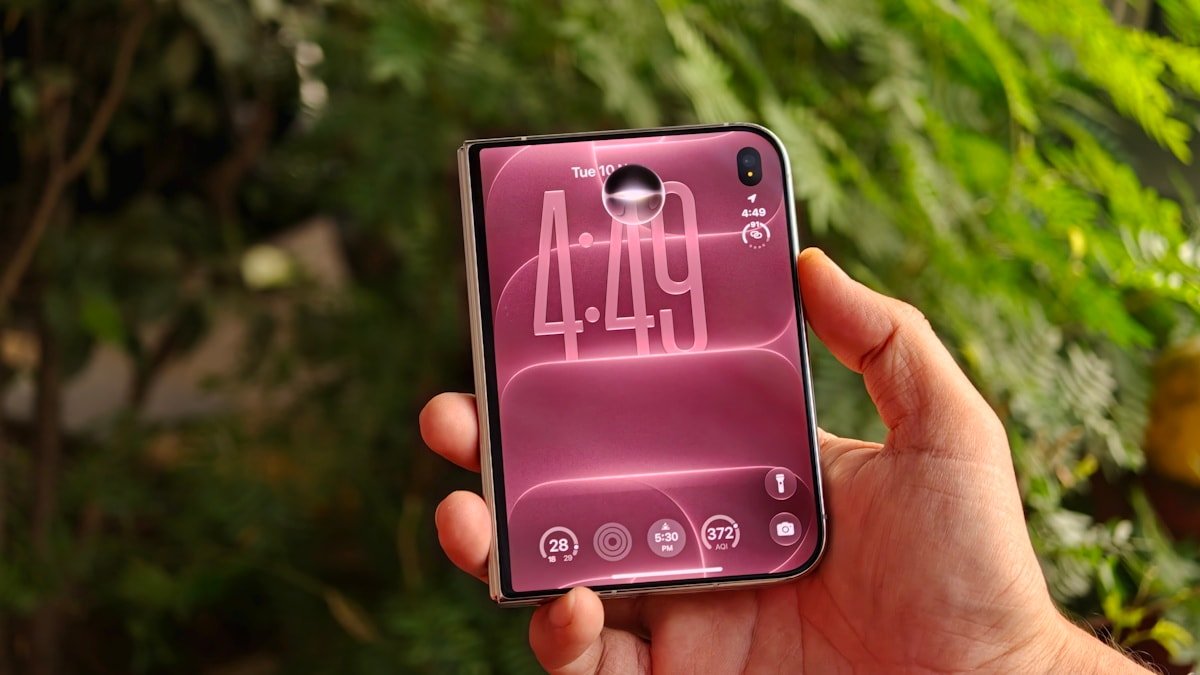
The engineering prowess behind the Iphone Duo is centered on its proprietary hinge architecture. Unlike early competitors that suffered from visible creases and mechanical fragility, Apple has opted for a multi-axial cam system. This mechanism allows the internal display to fold into a “teardrop” shape, minimizing the stress on the OLED panel and effectively eliminating the central ridge that has plagued foldable devices since their inception. The cover screen remains a functional 5.4-inch display, maintaining the familiar ergonomics of the standard iPhone, while the inner display unfolds to a tablet-like 8.2-inch canvas.
Under the hood, the device is powered by the latest A-series silicon, specifically optimized for thermal management in a dual-chassis configuration. Because the internal components are split between the two halves of the device, Apple had to redesign the logic board to ensure parity in heat dissipation and battery distribution. The battery is bifurcated, utilizing a high-density, multi-cell design that supports rapid charging protocols. Benchmarks indicate that the device maintains performance parity with the standard flagship lineup, despite the increased complexity of the internal cabling and the software overhead required to manage the dynamic display transition.
The display technology itself employs a low-temperature polycrystalline oxide (LTPO) backplane, allowing for a variable refresh rate of 1Hz to 120Hz. The integration of a custom-engineered ultra-thin glass (UTG) layer provides a tactile experience that mimics traditional glass, a significant improvement over the softer plastic polymers used in early-generation foldables. This hardware foundation is supported by a bespoke version of iOS, which introduces “Continuity Fold,” a software layer that manages the fluid transition of applications between the cover and inner screens.
Industry Landscape and Competitive Comparison
Apple’s entry into the foldable space is undeniably late, arriving years after Samsung and Google established their dominance in the category. This delay has allowed Apple to observe the failures and successes of its rivals, yet it also invites immediate scrutiny. While the hardware build quality is superior to most current market offerings, the software ecosystem remains in its infancy. For power users, the lack of mature multitasking features—compared to the refined split-screen capabilities found on Android—is a notable limitation.
The following table illustrates the current positioning of the Iphone Duo relative to the established market leaders:
| Metric | Iphone Duo | Samsung Galaxy Z Fold | Google Pixel Fold |
|---|---|---|---|
| Build Quality | Exceptional | High | Good |
| Software Polish | In Progress | Mature | Mature |
| Crease Visibility | Negligible | Moderate | Moderate |
| Base Price | Rs. 2,99,900 | Rs. 1,64,999 | Rs. 1,59,000 |
The pricing strategy is perhaps the most contentious aspect of the launch. At Rs. 2,99,900, the Iphone Duo is not aimed at the average consumer. It is positioned as a luxury asset, occupying a price tier that effectively excludes it from the standard upgrade cycle. By setting the barrier to entry this high, Apple is signaling that the foldable form factor is currently a premium experiment rather than a replacement for the traditional iPhone.
Practical Consumer & Enterprise Takeaways
For the average consumer, the Iphone Duo presents a significant value proposition challenge. If your primary use case involves standard communication, social media, and photography, the standard iPhone remains the more pragmatic and cost-effective choice. The durability of foldable screens, despite Apple’s engineering advancements, remains an unknown variable compared to the proven longevity of static glass displays.
From an enterprise perspective, the device offers potential for mobile productivity. The ability to view complex spreadsheets, architectural schematics, or multi-window workflows on an 8.2-inch display can be a genuine asset for field-based professionals. However, IT departments will need to weigh the productivity gains against the high replacement costs and the potential for mechanical failure. Furthermore, organizations must verify that their proprietary software is optimized for the unique aspect ratio of the internal display, as poorly scaled applications can diminish the utility of the hardware.
Frequently Asked Questions
Is the Iphone Duo’s hinge mechanism rated for long-term daily use?
Apple claims the hinge has been tested for over 200,000 cycles. While this matches industry standards, real-world longevity will depend on environmental factors such as dust and particulate exposure, which remain the primary enemies of all foldable hardware.
Does the current version of iOS support true multitasking on the inner display?
The current iteration offers basic split-screen functionality and app continuity. While it is stable, it lacks the advanced window-management features found on competing platforms, which is an expected focus for future software updates.
Is the internal display prone to scratching or damage compared to standard iPhones?
The device uses a specialized ultra-thin glass. While it is significantly more durable than early plastic-covered foldables, it is still more susceptible to deep scratches from sharp objects than the hardened ceramic-shield glass used on standard iPhone models.
The Bottom Line
The Iphone Duo is a testament to Apple’s engineering capability, proving that the company can execute a complex form factor with a level of refinement that its competitors have struggled to achieve. However, it is not yet a product for the masses. With its prohibitive price and nascent software ecosystem, it serves as a sophisticated prototype for a future that has not yet fully arrived. For the early adopter and the brand loyalist, it represents the pinnacle of current mobile hardware. For the pragmatic user, the device is a clear indicator of where the industry is headed, even if the destination is still several years away from becoming a standard utility.
