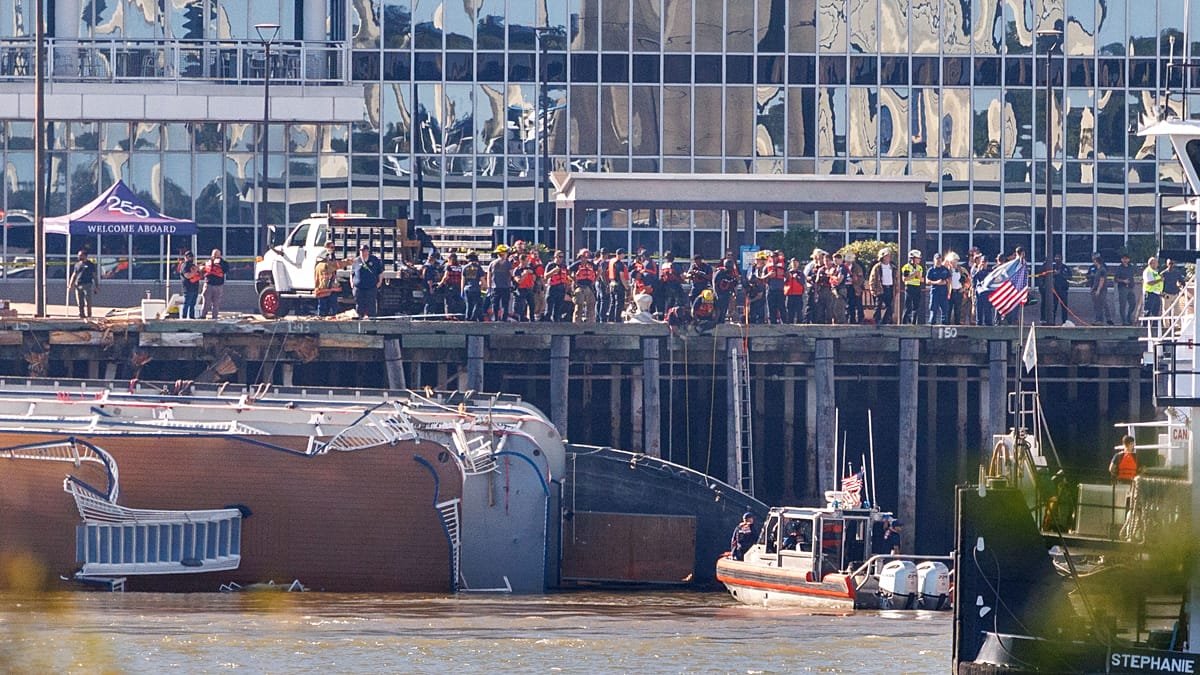
Technical Specifications and Architectural Breakdown
From an engineering perspective, the American Heritage represents a design philosophy that prioritizes period-accurate aesthetics over modern structural resilience. The vessel, styled after traditional paddlewheelers, lacks the sophisticated damage-control architecture standard in contemporary maritime engineering. In modern naval architecture, vessels are designed with extensive compartmentalization—a series of watertight bulkheads that prevent a single hull breach from compromising the buoyancy of the entire ship. The American Heritage, by contrast, relies on a more open hull configuration that offers little resistance to the kinetic energy transfer inherent in a collision with a modern, high-tonnage tanker.
Furthermore, the material science utilized in the vessel’s construction is fundamentally different from current safety benchmarks. Modern ships utilize high-tensile steel alloys and energy-absorbing structural frames designed to deform in a controlled manner during impact, thereby protecting the ship’s internal core. The American Heritage operates on a legacy framework that lacks these specialized steel grades. This structural vulnerability was clearly demonstrated by the rapid rate at which the vessel took on water. Without automated proximity sensors or computer-assisted maneuvering systems—technologies that are now standard in commercial shipping to mitigate human error—the vessel remains highly susceptible to the unpredictable dynamics of busy river ports.
Industry Landscape and Competitive Comparison
The maritime industry is currently bifurcated between vessels built for the experience economy and those built for logistics-grade safety. While passengers flock to the American Heritage for its historical charm, the operational risks are stark when compared to modern river cruise vessels or standard commercial ferry platforms. The following table highlights the disparity in safety-critical systems between the American Heritage and contemporary industry standards.
| Safety Metric | Modern River Cruise Vessel | American Heritage |
|---|---|---|
| Hull Construction | High-Tensile Steel / Double Hull | Traditional / Single Hull |
| Collision Avoidance | Digital Proximity Radar / AIS | Manual / Visual Observation |
| Compartmentalization | Multi-stage Watertight Bulkheads | Limited / Open Configuration |
| Emergency Protocols | Automated Deployment Systems | Manual / Crew-Dependent |
This comparison is not merely academic; it represents a fundamental shift in how regulators and operators must view inland waterway navigation. While modern vessels integrate AI-driven collision avoidance systems that calculate closing speeds and vectors in real-time, the American Heritage relies on the traditional, manual vigilance of the pilot house. In a port environment where commercial tankers are increasingly automated or assisted by sophisticated bridge systems, the presence of a legacy-designed vessel creates an asymmetrical safety profile that is increasingly difficult to justify.
Practical Consumer & Enterprise Takeaways
For the cruise industry, the incident in New Orleans presents a difficult cost-benefit analysis. Retrofitting a heritage vessel with modern safety features—such as double-hull reinforcement or advanced radar-linked collision avoidance systems—is often prohibitively expensive and can compromise the very aesthetic that attracts passengers. Operators are faced with two choices: either restrict the operational zones of these vessels to low-traffic, secondary waterways, or invest in extensive structural upgrades that may fundamentally alter the vessel’s historical character.
For consumers, the takeaway is a shift in risk assessment. Prospective travelers should inquire about the safety certifications and recent structural audits of any vessel they board, particularly those that market themselves on their vintage design. While the industry maintains a high safety record, the American Heritage incident underscores that “vintage” often implies a lack of modern safety redundancies. Enterprise operators must now consider whether the marketing value of a classic design outweighs the potential liability of operating in high-density, high-risk traffic zones without the benefit of modern collision-mitigation technology.
Frequently Asked Questions
Why are heritage vessels allowed to operate in high-traffic ports if they lack modern safety systems?
Maritime regulations are often grandfathered in for older vessels, provided they meet the basic safety requirements established at the time of their construction or last major refit. However, the American Heritage incident is likely to prompt regulators to revisit these exemptions, potentially requiring mandatory upgrades for any vessel operating in commercial shipping lanes.
Could the collision have been prevented by modern technology?
While no system is infallible, modern collision-avoidance systems (CAS) utilize real-time radar and AIS data to alert bridge crews of potential intercept courses long before a visual sighting. Had the American Heritage been equipped with such systems, the crew might have had the additional minutes required to adjust their course or speed, potentially avoiding the impact entirely.
Is the American Heritage design inherently unsafe for passengers?
It is more accurate to say that the design is less resilient to modern threats. In calm, isolated waters, the vessel’s design is sufficient. The risk arises when that design is placed in a modern, high-density environment where it is expected to interact safely with much larger, more robust commercial vessels.
The Bottom Line
The collision involving the American Heritage is a wake-up call for the maritime sector. It highlights the inherent tension between preserving our nautical history and ensuring the safety of those who participate in it. While the charm of a paddlewheeler is undeniable, the engineering reality is that these vessels are relics of an era that did not have to contend with the scale and speed of modern commercial shipping. Moving forward, the industry must prioritize the integration of modern safety technologies into legacy platforms, or accept that certain heritage vessels may no longer be suitable for the complexities of today’s busy inland waterways. Safety cannot be sacrificed for the sake of nostalgia.
